If your current wordpress autoblogging setup still pulls RSS feeds, rewrites a few sentences, and publishes automatically, it’s already on borrowed time. The risk isn’t “AI content” as a label. It’s thin pages, duplicated ideas, and a site that looks like nobody would defend it if a human reviewer opened the tab.
📋 In this article:
- What WordPress autoblogging really means in 2026
- What gets a WordPress autoblog penalized
- Why Google’s guidance matters more than the tool
- What a defensible autoblogging workflow looks like
- AI-assisted publishing vs the old RSS-scrape model
- Signals that your WordPress autoblog is drifting into thin-content territory
- What new sites should expect from wordpress autoblogging
- How WordPress autoblogging in 2026 fits into real SEO work
The good news is that WordPress autoblogging in 2026 can still work. The version that survives looks like an editorial workflow with automation around it, not a content firehose with a plugin attached. That distinction matters if you care about rankings, affiliate revenue, or your domain’s long-term reputation.
What WordPress autoblogging really means in 2026
Today, wordpress autoblogging usually means AI-assisted drafting, content collection, formatting, scheduling, and publishing inside WordPress. That’s a broad umbrella. It covers a niche site using ChatGPT or Claude to draft product roundups, a news-style site that auto-imports source material for human review, and a WooCommerce store that generates category copy and FAQs in batches. It doesn’t automatically mean spam.
The older model was simpler and uglier. Pull an RSS feed, spin it, publish it, repeat. That approach had one job: manufacture pages faster than anyone could inspect them. Search engines got better at spotting the pattern, users got better at recognizing junk, and the whole trick got harder to hide. A modern autoblog can still be legitimate if the output is original enough to deserve space on the site and the process includes editorial control.
That’s the answer most site owners want first: yes, the concept is viable in 2026, but only when it produces pages a real person would keep open for more than six seconds.
What gets a WordPress autoblog penalized
Google’s issue isn’t that something was drafted with ChatGPT or Claude. Google’s issue is pages that add little or nothing new. If the article reads like a remix of ten other pages on the same query, you’re asking for trouble. If the site publishes at scale with no review, no topical restraint, and no unique angle, the penalty risk climbs fast. That’s true whether the content came from a human freelancer or an AI model.
The old autoblogging habit created predictable footprints. Recycled product descriptions. Duplicate summaries from feed imports. Keyword-swapped pages that differ only in city name, tool name, or year. Sites built this way tend to look busy while remaining strategically empty. Search engines aren’t impressed by page count if the pages all say the same thing with different hats on.
Scraped feeds and duplicate summaries
This one is still the most obvious mistake. If your posts are basically copied source blurbs with a few rewritten phrases, you’ve built a machine for duplicate intent. Even when you aren’t copying text verbatim, publishing near-identical summaries of the same sources across dozens of URLs creates a trust problem for readers and crawlers alike.
Spun or lightly rewritten content with no original value
Spinning used to be a cheap way to dodge exact-match duplication. It was never clever, just noisy. The modern version is cleaner on the surface and equally weak underneath.
If your article has no original structure, no practical judgment, and no reason to exist beyond ranking for a keyword, it will age badly. That’s especially true in affiliate niches where buyers can sniff out generic advice from a mile away.
Auto-published pages that no human ever checks
This is where lazy automation really bites. A queue is fine. Instant publishing without review is where many sites go off the road. When no one checks titles, formatting, links, factual claims, or image choices, errors pile up fast. One sloppy post is tolerable. Fifty of them create a pattern.
Speed is not an editorial strategy.
Why Google’s guidance matters more than the tool
Search engines keep making the same point: helpful content wins, empty content loses. That’s held through multiple algorithm changes, and it still does. Whether you drafted the page with ChatGPT, Claude, GPT-5.5, or an old-school freelance writer matters a lot less than whether the page helps someone finish the task they came for. The tool is background noise. The page quality is what gets judged.
That means E-E-A-T still matters in practice, even if people argue about the acronym online like it’s a hobby sport. Real signals help: clear authorship where appropriate, useful structure, accurate product references, sensible internal links, and content that sounds like it was edited by someone who knows the niche. Google doesn’t reward effort alone. It rewards usefulness that can survive scrutiny.
There’s a blunt reality here too. AI-assisted publishing makes mediocrity cheaper. That doesn’t make mediocrity acceptable. If your workflow lowers cost but also lowers standards, you’ve bought yourself more output and less trust. That tradeoff is why some sites fail after an initial burst of publishing enthusiasm.
What a defensible autoblogging workflow looks like
A defensible workflow starts before any prompt gets typed. Choose topics with boundaries. Decide what the site covers and what it refuses to cover. Then use AI to speed up drafting, outlining, formatting, and cleanup inside WordPress. The order matters because automation should support editorial judgment, not replace it.
Tools like MrNiche Autoblogger Pro can handle parts of that pipeline automatically, including queued publishing and post generation in the background, but the useful part is still the workflow around it: topic selection first, drafting second, review before publish. If your process doesn’t include human judgment somewhere before hitting “publish,” you’re gambling with the domain.
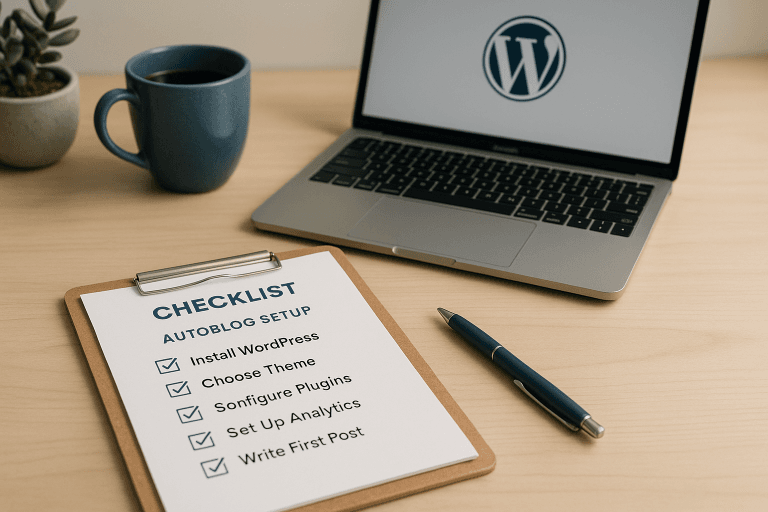
The practical guardrails are boring, which is usually a good sign:
- A queue instead of instant publishing
- Human review before publish
- Clear topical boundaries for each category
- Internal links that point to genuinely related posts
- Images and headings that match reader intent
A lot of site owners want automation to behave like magic. It doesn’t. It behaves like process enforcement.
If your categories are sloppy or your editorial rules are nonexistent, automation will happily make the mess bigger and faster. For a deeper look at that side of it, see AI WordPress SEO mistakes….
AI-assisted publishing vs the old RSS-scrape model
The difference between old-school autoblogging and current AI-assisted publishing is intent plus control. The old model copied existing material and hoped volume would outrun scrutiny. The current model starts with original intent and uses automation to reduce production friction. One model is parasitic. The other can be legitimate if someone actually edits what goes live.
This is where WordPress helps more than people admit. Plugins like Yoast SEO and Rank Math make it easier to standardize titles and meta descriptions. Elementor can help shape templates so your article pages don’t look thrown together by accident. AI helpers such as AI Engine or Bertha AI can draft faster than a blank editor ever will. None of that fixes bad judgment, but it does make decent judgment cheaper to apply consistently.
That difference matters when a reviewer lands on your site and asks one question: does this feel like a publication or a machine dump? You want them leaning toward publication every time.
Signals that your WordPress autoblog is drifting into thin-content territory
This part is easy to miss because a site can look productive while becoming strategically hollow. You’ve got fresh posts coming in every day, maybe even decent traffic on a few pages, but the actual content quality has started sliding sideways. Thin-content problems usually show up as patterns, not disasters.
Watch for repetitive openers across posts, product roundups that only change the keyword, category archives with no real hierarchy, and articles that feel assembled instead of written. If every page starts with the same polite throat-clearing before getting to nothing much at all, readers notice, even when analytics haven’t started yelling yet.
The bigger trap is confusing quantity with progress.
A smaller site with edited articles and clear topical depth often beats a larger site stuffed with forgettable pages.
Google doesn’t owe you anything for filling your sitemap like it’s a storage locker.
Keyword-swapped pages that say the same thing
If you can replace “best running shoes” with “best trail shoes” and keep 90 percent of the article intact, you’ve got templated emptiness pretending to be content strategy.
Category sprawl without topical depth
Too many categories usually mean planning happened after publishing started.
A site about coffee shouldn’t need twelve buckets before it has three solid articles under each one.
Published fast, edited never
This shows up in broken formatting, vague claims, stale references, missing internal links, and titles that read like they were approved by committee.
What new sites should expect from wordpress autoblogging
A new domain doesn’t get special treatment just because your publishing workflow is efficient. If anything, it gets judged harder because there’s no history yet to earn trust from users or search engines. Autoblogging won’t rescue a weak niche choice or an incoherent site structure. It can help you build momentum faster once you already know what kind of site you’re making.
If the goal is affiliate income, your early articles need to do more than fill space around keywords.
They need to answer specific questions clearly enough that a visitor would actually use them before buying somewhere else.
That means original angles, sensible comparison points, real product names when they matter, and editing that strips out generic filler before it ever reaches the front end. For a deeper look at that side of it, see Common WordPress Automation Mistakes….
You also need patience about indexing and traction.
A new site stuffed with automated posts can look impressive to its owner and invisible to everyone else.
That’s not mysterious. It’s what happens when output gets ahead of usefulness.
How WordPress autoblogging in 2026 fits into real SEO work
If you want this model to last long enough to matter, treat automation as production support and SEO as editorial discipline. Rank Math or Yoast can handle on-page basics, but they won’t save a weak topic map. Internal linking can help distribute authority across related posts, but only if those posts actually belong together. Even image handling matters here because generic stock art from Unsplash looks better than random filler thumbnails slapped into place five minutes before publish.
The better sites tend to have restraint built in. They publish fewer categories than they think they need. They avoid repeating themselves across keyword variations. They use AI for drafting when it saves time and edit hard when the draft sounds too smooth for its own good.
The better sites tend to edit harder than their competitors do; that usually wins over cleverer prompts. (See also: Best AI WordPress Plugins…)
That last part matters more than some people want to admit.
This week, audit one automated content stream in your WordPress dashboard and ask whether each post would still be worth publishing if a human editor had to sign their name under it; if the answer is shaky more than twice in a row, stop the queue and tighten your wordpress autoblogging rules before you publish another page.
If you want the shorter version of this argument alongside the rest of our testing, start with our autoblogger guides.